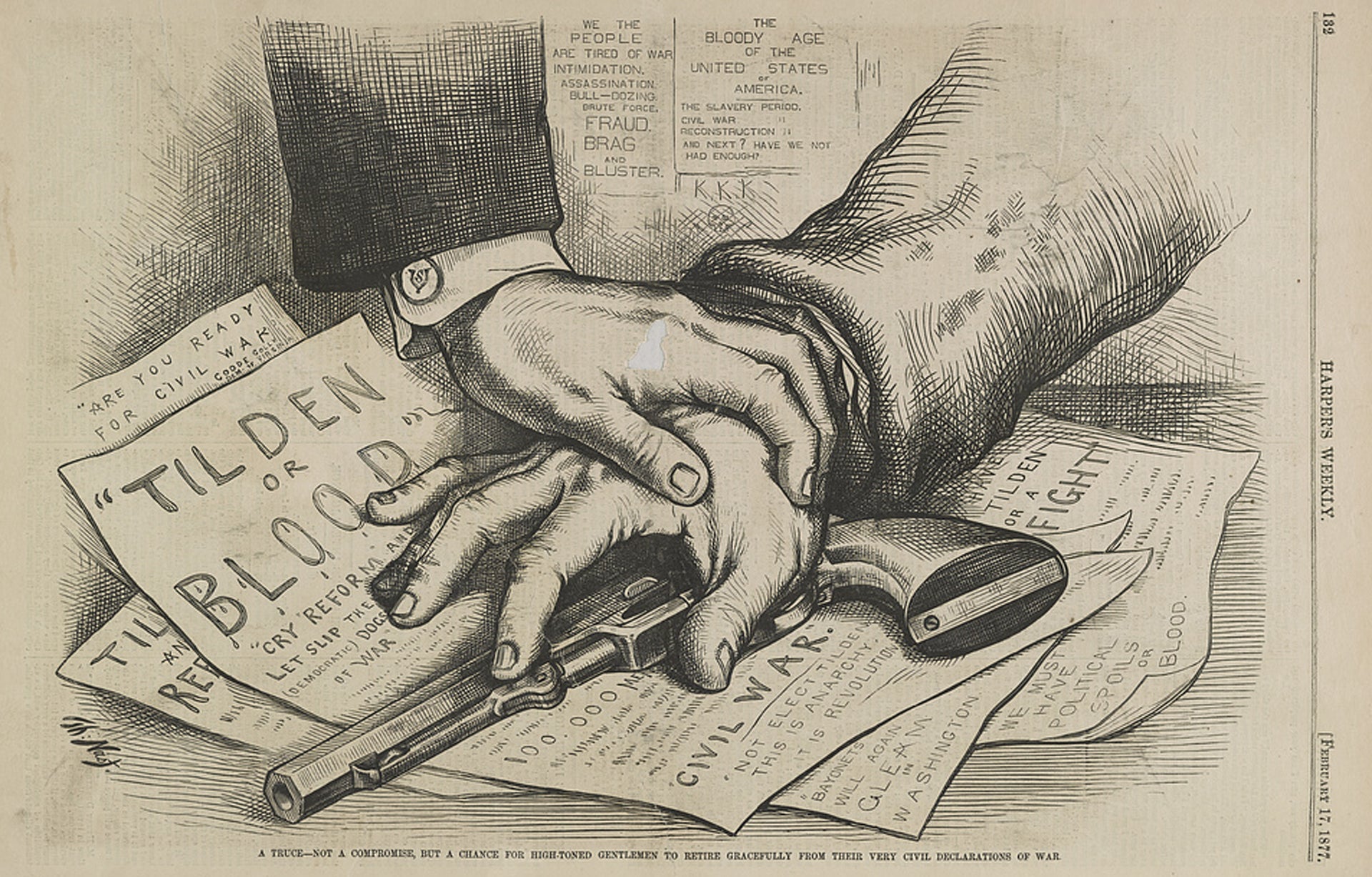
The Compromise of 1877 and Rutherford B. Hayes’ Path

marydilip.info – The Compromise of 1877 was a pivotal moment in American history that not only brought an end to the Reconstruction era but also altered the course of the presidency. The agreement, which settled the fiercely contested 1876 presidential election, resulted in Rutherford B. Hayes assuming office. In this article, we will explore the circumstances surrounding the Compromise of 1877, the political and social climate of the time, and how Rutherford B. Hayes navigated a complex and contentious path to the White House.

The 1876 Presidential Election: A Divided Nation

The 1876 presidential election was one of the most contentious in American history, set against a backdrop of post-Civil War recovery, the lingering tensions of Reconstruction, and racial tensions in the South. The two main candidates were Rutherford B. Hayes, the Republican governor of Ohio, and Samuel J. Tilden, the Democratic governor of New York.

A Nation Still Rebuilding

After the Civil War, the United States was still reeling from the economic, political, and social changes brought on by the conflict. The Reconstruction era, which aimed to reintegrate the Southern states into the Union and provide civil rights protections to freed African Americans, had seen significant progress, but it was deeply controversial. Many Southerners resisted Reconstruction, and racial violence and political corruption were rampant in the South.

By 1876, the Republican Party, which had led Reconstruction efforts, was starting to lose its popularity. Many Northern voters were weary of the ongoing efforts to reform the South, while Southern Democrats were eager to regain control of their states and reverse the changes imposed during Reconstruction.

The Candidates and the Controversy

The Republican candidate, Rutherford B. Hayes, was seen as a moderate who had supported civil rights during his tenure as governor of Ohio. On the other hand, Samuel J. Tilden, the Democratic candidate, was viewed as a reformer who had fought against corruption in New York and promised to end the influence of special interests in government. Tilden had a strong lead in the popular vote and appeared to have won the electoral vote as well.

However, disputes arose over the results in several Southern states, including Florida, Louisiana, and South Carolina, where both parties claimed victory. The results in these states were highly contested, with allegations of voter suppression, fraud, and intimidation.

The Electoral Crisis and the Need for Resolution

As the country awaited the final electoral count, it became clear that no candidate had a clear majority in the electoral college. This created a crisis, as the Constitution did not provide a clear mechanism for resolving such a deadlock. With the nation’s political stability at stake, a solution was needed quickly to prevent further unrest and division.

The Formation of the Electoral Commission

In January 1877, Congress created a special Electoral Commission to resolve the dispute. The commission was made up of 15 members, with representatives from the House, Senate, and the Supreme Court. It was tasked with determining which set of electoral votes from the contested Southern states would be counted.

The commission was heavily partisan, with eight Republicans and seven Democrats. After weeks of deliberation, the commission voted along party lines to award all of the disputed electoral votes to Hayes, giving him a narrow victory of 185 electoral votes to Tilden’s 184. While Hayes had won the electoral vote, Tilden had won the popular vote by a margin of over 250,000.

The Threat of Civil Unrest

The announcement of Hayes’ victory was met with widespread outrage, particularly in the South. Many Democrats, and especially Southern Democrats, refused to accept the outcome and saw it as a betrayal of the will of the people. Riots and protests erupted, and there were even threats of violence against the government.

In this tense atmosphere, it became clear that a compromise was necessary to avoid further unrest and to ensure a peaceful transition of power.

The Compromise of 1877: A Deal to End Reconstruction

The Compromise of 1877, also known as the Hayes-Tilden Compromise, was the result of backdoor negotiations between Republican and Democratic leaders. The deal effectively ended Reconstruction and allowed Rutherford B. Hayes to assume the presidency. In exchange, Hayes agreed to several concessions aimed at appeasing the South.

The Terms of the Compromise

The key elements of the Compromise of 1877 included:

  1. The Withdrawal of Federal Troops from the South: One of the most significant aspects of the compromise was Hayes’ agreement to withdraw federal troops from the Southern states. This decision marked the end of Reconstruction and allowed Southern Democrats to regain control of their state governments. The removal of federal troops also led to the erosion of the political and civil rights of African Americans in the South, as white supremacist groups such as the Ku Klux Klan were able to reassert their dominance.

  2. Southern Democrats in Key Positions: Hayes agreed to appoint at least one Southern Democrat to his cabinet, which helped ensure that the South would have a voice in the federal government. This move was intended to placate Southern leaders who had long felt disenfranchised by Republican rule.

  3. Federal Investment in Southern Infrastructure: The compromise also included promises of federal investment in Southern infrastructure, such as railroads, to promote economic development and improve relations between the North and South.

The End of Reconstruction and Its Consequences

The withdrawal of federal troops from the South had profound consequences for African Americans in the region. Without the protection of the federal government, many Southern states enacted discriminatory laws, known as Jim Crow laws, which disenfranchised African Americans and institutionalized racial segregation. The Compromise of 1877 thus marked the end of the Reconstruction era and the beginning of an era of racial inequality and oppression in the South that would persist for decades.

Rutherford B. Hayes’ Presidency and Legacy

Rutherford B. Hayes’ path to the presidency, secured through the Compromise of 1877, marked a turning point in American history. While his presidency was short-lived, Hayes is often remembered for his efforts to reform the civil service and his commitment to promoting education and infrastructure.

Civil Service Reform

One of Hayes’ key achievements as president was his commitment to civil service reform. He took steps to reduce political patronage and corruption by advocating for merit-based appointments to government positions. His efforts paved the way for the Pendleton Civil Service Reform Act of 1883, which established a more professional and impartial federal workforce.

Hayes and the South

While Hayes’ withdrawal of federal troops from the South was seen as a necessary concession to ensure a peaceful transition of power, it has been criticized by some historians as a betrayal of African Americans’ civil rights. The end of Reconstruction and the rise of Jim Crow laws in the South were direct consequences of the compromise, and many of the promises made to African Americans during Reconstruction were left unfulfilled.

Legacy of the Compromise

The Compromise of 1877 remains a controversial chapter in American history. While it allowed for the peaceful transfer of power and ended the immediate crisis, it also marked the end of federal efforts to protect the rights of African Americans in the South. The political balance struck in the compromise would have lasting effects on the development of race relations and civil rights in the United States.

Conclusion

The Compromise of 1877 was a critical event in the history of the United States, shaping the political and social landscape for years to come. Rutherford B. Hayes’ path to the White House was marked by political maneuvering, contested elections, and the eventual compromise that ended Reconstruction. While Hayes’ presidency brought some reforms, the long-term consequences of the compromise – particularly for African Americans in the South – were deeply damaging and would reverberate throughout American history.
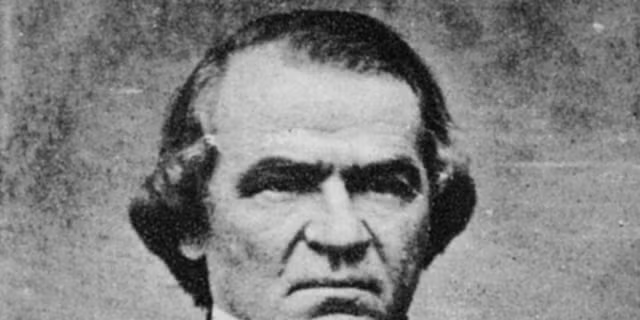
Andrew Johnson’s Path to the White House

marydilip.info – Andrew Johnson, the 17th President of the United States, is a figure whose ascent to the highest office in the land is marked by a series of improbable events, a deep commitment to the Union, and an unyielding belief in states’ rights. His life story, from his humble beginnings as an impoverished tailor’s apprentice to becoming president after the assassination of Abraham Lincoln, reveals a man who was deeply shaped by the turbulent political and social landscape of the time. Johnson’s path to the White House was neither smooth nor straightforward, and his legacy as president remains highly controversial. However, his journey through adversity is an essential part of American history.

This article explores Andrew Johnson’s life, his rise through the ranks of local and national politics, and his eventual, unexpected rise to the presidency. Understanding his path to the White House requires an examination of his personal background, his early political career, his role as military governor of Tennessee, and his selection as Abraham Lincoln’s vice president—culminating in his controversial presidency.

Early Life: Humble Beginnings in North Carolina

Born into Poverty

Andrew Johnson was born on December 29, 1808, in Raleigh, North Carolina, into a poor family. His father, Jacob Johnson, was a worker, but the family lived in abject poverty. Johnson’s mother, Mary McDonough, was left to raise him and his siblings when his father died when Andrew was just three years old. Without much formal schooling, Johnson’s early life was one of hardship, and he was forced to work to support his family from a very young age.

At the age of 10, Andrew Johnson was apprenticed to a local tailor, where he learned the trade that would define much of his early life. Despite his lack of formal education, Johnson developed a strong sense of self-reliance and ambition. He was determined to rise above his humble beginnings. His experience as a tailor also provided him with a unique perspective on the challenges faced by ordinary working people, which would shape his later political views.

Moving to Tennessee: A New Start

At the age of 18, Andrew Johnson moved to Greeneville, Tennessee, where he continued to work as a tailor. It was in Tennessee that Johnson would begin his rise in local politics. He married Eliza McCardle in 1827, and the couple would have five children together. Johnson’s wife was instrumental in his self-education, teaching him to read and write—skills he would later use to enhance his political career.

In Greeneville, Johnson became active in local politics, where his populist appeal and personal drive gained him the respect of his community. His political career began in earnest in 1830 when he was elected to the Greeneville town council. Over the next decade, he gradually moved into higher levels of public service, and in 1835, Johnson was elected mayor of Greeneville.

Johnson’s early political ideology was shaped by his experiences as a self-made man, and he became known as a defender of the common people. His platform focused on economic opportunity, infrastructure development, and the rights of poor whites. He also became a vocal critic of the elite class and of wealthy landowners. His politics would later shift, but his early populist convictions played a key role in building his political base.

From State Politics to the U.S. Senate

The Rise to the Tennessee Legislature

In the 1830s, Andrew Johnson’s growing political influence in Tennessee led him to higher office. In 1835, he was elected to the Tennessee state legislature, where he served for several years. His rise in the state legislature was a result of his ability to connect with working-class voters and his opposition to the economic policies that favored the elite and wealthy landowners.

As a member of the state legislature, Johnson began to make a name for himself as a staunch advocate for internal improvements, such as better roads and infrastructure, which he believed would help foster economic opportunity for poorer Tennesseans. Johnson also became known for his defense of states’ rights, a position that would become central to his political philosophy later in life.

U.S. House of Representatives: A National Figure Emerges

In 1843, Andrew Johnson’s political career took a significant leap when he was elected to the U.S. House of Representatives. He served as a member of the House from 1843 to 1853, where he became known for his support of President James K. Polk’s agenda and his advocacy for tariffs to protect American industry. Johnson’s populist rhetoric and his consistent support for internal improvements earned him the loyalty of working-class voters, particularly those in the South.

During his time in Congress, Johnson developed a reputation as a pragmatic and independent politician. Though he supported many Democratic Party initiatives, he often found himself at odds with the party leadership, especially on issues related to slavery and the expansion of the nation. Johnson was firmly against the spread of slavery into new territories, but he was not an abolitionist. His opposition to the expansion of slavery was based on the belief that the institution would undermine the opportunities for poor whites.

Governor of Tennessee: Shaping Southern Politics

After leaving Congress in 1853, Andrew Johnson was elected governor of Tennessee in 1853, a position he held until 1857. His time as governor further cemented his reputation as a man of the people, as he championed policies designed to improve the lives of poor white farmers and working people. Johnson’s approach was a mix of economic populism and moderate stances on slavery. He opposed the expansion of slavery into new territories but remained a loyal Democrat and supported states’ rights.

Johnson’s time as governor also saw his first real encounters with the growing political divisions over slavery and the secessionist movement in the South. As the nation edged closer to Civil War, Johnson was a vocal critic of secession and argued for the preservation of the Union. His loyalty to the Union would eventually lead him to make the decision that would change the course of American history.

Civil War and the Military Governorship of Tennessee

The Civil War: A Unionist in a Divided South

When the Civil War broke out in 1861, Johnson found himself in a difficult position. Though he was a Southern Democrat, he was strongly opposed to secession and believed that the South should remain part of the Union. He was one of the few Southern politicians to oppose the Confederacy. As Tennessee seceded and joined the Confederate States of America, Johnson’s political future seemed uncertain.

In 1862, following the Union’s military victory in Tennessee, President Abraham Lincoln appointed Andrew Johnson as the military governor of Tennessee. This role would prove to be crucial to Johnson’s future political fortunes. As military governor, Johnson was tasked with overseeing the restoration of Union rule in the state. His approach was conciliatory toward the South, focusing on reconciliation and quick re-entry into the Union without excessive punishment of former Confederates.

Johnson’s Military Governance and His Popularity in the North

During his time as military governor, Johnson became increasingly popular in the North. He was hailed as a Unionist hero who had remained loyal to the United States despite the strong Confederate sympathies in his home state. Johnson’s efforts to restore civilian rule in Tennessee and his willingness to offer amnesty to many former Confederates earned him praise from President Lincoln and the Republican Party.

By the time of Lincoln’s re-election in 1864, Johnson had become a prominent figure in national politics. His selection as Lincoln’s vice-presidential running mate was seen as a strategic move to appeal to Southern Unionists and to demonstrate the President’s commitment to national reconciliation.

Vice President and Ascension to the Presidency

The 1864 Election: A Union Ticket

In the 1864 presidential election, Lincoln sought re-election during a time of great national crisis. He faced a divided nation and a country embroiled in civil war. In order to broaden his appeal, especially in the South and among Unionists, Lincoln chose Johnson, a Southern Unionist, as his running mate.

The inclusion of Johnson on the ticket was meant to signal to Southern Unionists and Northern Democrats that Lincoln was committed to healing the nation’s wounds. The ticket of Lincoln and Johnson represented national unity and a vision of reconciliation between the North and South. They were elected in a landslide victory.

The Assassination of Abraham Lincoln: Johnson Takes Office

Tragedy struck just weeks after the election when President Lincoln was assassinated on April 14, 1865, by John Wilkes Booth. With Lincoln’s death, Vice President Andrew Johnson was thrust into the presidency at a critical moment in American history. The nation was left in shock, and the future of the Union and the newly freed slaves was uncertain. Johnson’s political experience and loyalty to the Union made him the logical successor, but his approach to Reconstruction would spark conflict with Congress and shape his presidency in ways that few could have anticipated.

Conclusion: An Unexpected Path to the White House

Andrew Johnson’s journey from a poor tailor in North Carolina to the 17th President of the United States is one of the most remarkable political stories in American history. His rise from humble beginnings to national prominence is a testament to his personal resilience, his ability to connect with ordinary Americans, and his unwavering commitment to the Union. However, his presidency, marked by deep political divisions and his controversial Reconstruction policies, ultimately led to a complex and contested legacy.

Though Johnson’s path to the White House was largely shaped by the tragedies and challenges of the Civil War, his time in office reminds us of the fragile nature of political unity in the aftermath of national conflict. Andrew Johnson’s presidency was a critical chapter in the history of Reconstruction, and his path to the White House stands as a defining example of political survival and the challenges of leading a nation divided.